
How to Install Surface Mounted LED Flat Panel Lights in the Ceiling?
LED panel lights are everywhere these days. They save energy and look great in both homes and offices. Whether it’s standard models, ultra-thin edge-lit panel led lights, or backlit panels, they are both practical and aesthetically pleasing.
Different spaces require different LED flat panel light installation approaches to achieve optimal lighting performance and safety. In this article, we will introduce the four most commonly used installation methods and provide practical suggestions.
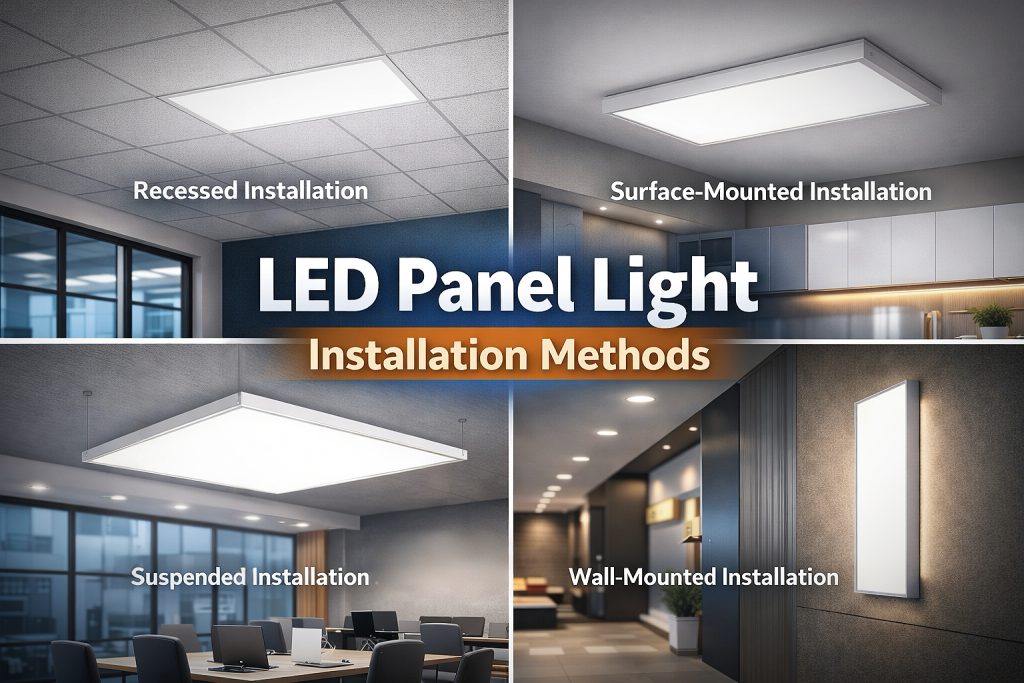
1. Recessed (Ceiling) Installation
Recessed mounting is often seen in modern spaces because it simply looks right. The light is placed into the ceiling grid instead of hanging below it. Once installed, the panel sits flat and blends into the ceiling naturally. This is why the 2×2 LED panel light is so widely used. Its size matches standard modular ceilings, so installation feels straightforward and familiar.
This installation style works well in offices, hospitals, and schools. These spaces need a neat ceiling layout and comfortable lighting for long hours of use. A recessed ceiling LED panel light also helps reduce glare. It makes the space easier on the eyes and lowers visual fatigue. Before installation, always turn off the power. Make sure the ceiling structure can properly support the panel size.

2. Surface-Mounted Installation
There’s simply no room above the ceiling?
So the led panel light has to stay outside instead of being hidden. In real projects, this situation is quite common. The mounting frame is fixed directly onto the ceiling surface, and the panel is installed from below. This is a straightforward approach often seen in surface-style led panel light installation.
Because the led flat panel light is very slim, the ceiling still looks neat. Even when the fixture is exposed, it doesn’t feel bulky or out of place. Over time, the frame plays a bigger role than many people realize. A solid aluminum frame helps manage heat more effectively and keeps the panel stable. It also reduces the chance of vibration or small light gaps after long-term use.

3. Suspended (Hanging) Installation
In suspended mounting, the led panel light is not fixed to the ceiling. It hangs below, supported by steel cables. You see this a lot in spaces where the ceiling is high and open. Offices, meeting rooms, and many commercial areas use this style for that reason, especially when ceiling panel light installation would place the fixture too close or limit design flexibility.
The height can be adjusted on site, which makes alignment much easier. The light stays level, and the space feels balanced. Because the panel is suspended, the ceiling itself is left as it is. Day-to-day maintenance is also easier. If the layout changes, the fixture can be moved without much trouble. This flexibility is one of the reasons suspended setups are popular in modern led panel lighting projects.

4. Wall-Mounted Installation
Wall installation gives a more decorative way to light a space. Panel lights can be installed vertically or at a slight angle. Their soft light creates a warmer atmosphere in rooms. Wall-mounted LED panel lights, which are often used in hallways, entrance halls, stairwells, and exhibition rooms, are particularly suitable for areas where lighting is often inadequate.
This setup works really well for panel lighting for wall applications. The light does more than just shine. It brings out architectural details while keeping the space clean and modern. It’s an easy way to mix function with style in any interior.

There are four common ways to mount a panel: recessed, surface-mounted, suspended, and wall-mounted. Each one works better in certain ceilings or for different design styles. Picking the right ceiling panel light installation can make your setup safer and last longer.
If you want even lighting from flat panel LED backlighting, or are looking for a led slim panel light for a modern room, knowing these options really helps. It makes choosing and installing the lights much easier.
Ready to upgrade your lighting? Find the right led light panel for your space and get in touch with us today. Our team can help you choose the best option and make sure your project shines.
Let ShineLong help you get the right lighting solutions for your space!
FAQs – LED Panel Light Installation Guide
1. How do you install a surface mounted LED panel light on a concrete ceiling?
To install a surface mounted LED panel light on a concrete ceiling, you need to first fix the mounting frame using expansion screws, then connect the driver and wiring, and finally secure the LED panel into the frame.
Surface mounted LED panel light installation is ideal when there is no ceiling cavity. Always check that the screws are suitable for concrete and that the frame is level before inserting the panel.
2. Can LED panel lights be installed without a suspended ceiling?
Yes. LED panel lights can be installed without a suspended ceiling by using surface mounting frames or suspension kits.
Surface mounted LED flat panel lights are commonly used in buildings with solid ceilings. Suspended installation is another good option when design flexibility is needed.
3. What is the easiest LED panel light installation method?
Surface mounting is usually the easiest LED panel light installation method because it requires minimal ceiling modification.
Compared with recessed installation, surface mounted LED panel light installation only requires fixing the frame and connecting power. This makes it a popular choice for renovation projects.
4. How much space is needed to install a recessed LED panel light?
A recessed LED panel light typically requires at least 2–6 inches (50–150mm) of ceiling depth to accommodate the fixture and driver.
Before recessed LED panel light installation, always measure the ceiling cavity and confirm driver placement to avoid installation problems.
5. Are suspended LED panel lights safe for high ceilings?
Yes. Suspended LED panel lights are very safe for high ceilings when installed with proper steel cables and mounting hardware.
Suspended LED panel light installation is widely used in offices and commercial buildings because it improves lighting distribution and accessibility.
6. Why are LED panel lights good for office lighting?
LED panel lights are ideal for office lighting because they provide uniform illumination, low glare, and high energy efficiency.
Recessed LED panel lighting is especially popular in offices because it creates a clean ceiling appearance and improves visual comfort.
7. How do you choose the right LED panel light size?
The right LED panel light size depends on the ceiling grid size and room dimensions. Common sizes include 600x600mm and 2×2 LED panel lights.
Choosing the correct panel size ensures easier installation and better lighting coverage.
8. Do surface mounted LED panel lights overheat?
No. Quality surface mounted LED panel lights are designed with aluminum frames and proper heat dissipation structures to prevent overheating.
A good LED panel light fixture should include thermal management features to ensure long lifespan and stable performance.
9. Can LED panel lights be mounted on walls?
Yes. LED panel lights can be wall mounted for decorative and functional lighting purposes.
Wall mounted LED panel light installation is often used in corridors, staircases, and exhibition areas to enhance architectural design.
10. What should you check before installing LED panel lights?
Before LED panel light installation, always check the power supply, ceiling strength, wiring safety, and mounting accessories.
Proper preparation ensures a safer LED panel lighting installation and reduces maintenance issues later.