
What Lighting is Required for Poultry?
1. What Type of Light is Best for Chickens?
On poultry farms, lights do more than just brighten the space — they directly affect how chickens grow, stay healthy, and produce eggs. The most suitable light source for chickens requires an appropriate spectrum, stable brightness, and controllable photoperiods. This is the importance of lighting in poultry farming. Because the quality of the lighting directly influences the farm’s profitability.
The optimal light source should simulate natural daylight while offering flexible adjustments tailored to the specific needs of the chicken coop.
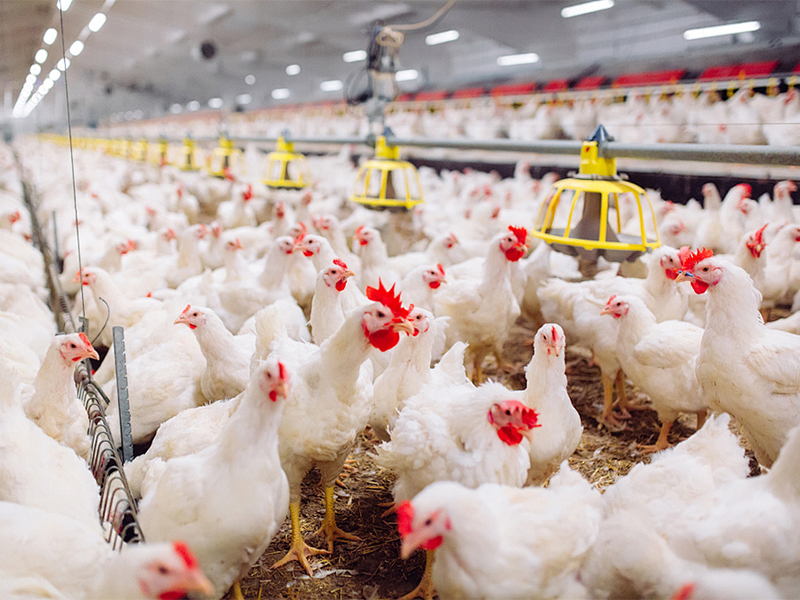
1.1 Natural Sunlight and Artificial Light
Natural light is the most ideal light source for chickens because it contains a full spectrum that maintains their normal physiological rhythms.
However, in modern farming environments, chicken coops are often enclosed or semi-enclosed for management convenience, preventing daily access to sufficient sunlight. Artificial light sources are then needed to compensate for this deficiency.
Artificial lighting can simulate sunrise and sunset through timed switches, helping flocks establish stable daily routines. Farmers often rely on artificial lighting, such as fluorescent lamps, traditional incandescent bulbs, and the now widely used LED lights. Compared to natural light, artificial lighting offers greater controllability and remains unaffected by weather conditions year-round. However, optimal results require scientifically selecting the appropriate spectrum and brightness levels.
Among various artificial lighting options, poultry LED lighting is gaining popularity in the industry due to its energy efficiency and adjustable characteristics.

1.2 LED Light for Poultry Houses
Compared with traditional lighting fixtures, LED poultry lighting offers greater energy efficiency, a longer lifespan, and more consistent, stable illumination. Lighting for poultry housing can be tailored with specific spectral solutions—like red-shifted light to support egg production or blue-shifted light to keep chicks calm and promote steady growth. Another key advantage is that LED poultry lighting produces very little heat, helping maintain optimal temperatures inside poultry housing.
On top of that, many modern LED poultry lighting systems come with smart controls that automatically adjust brightness and schedules to simulate natural light cycles, significantly reducing operational costs.
Click The Image To Learn More 👇

2. What Does LED Light Do to Chicken?
2.1 Effects on Chicken Growth and Behavior
Lighting affects chicken growth and interactions.
Excessive light intensity may cause flocks to become restless or even exhibit aggressive behavior, while insufficient light can lead to reduced activity, decreased feed intake, and diminished social interaction. Therefore, poultry lighting equipment with moderate intensity helps maintain flock stability.
Additionally, after understanding poultry lighting, artificially adjusted lighting can better mimic the natural variations in light intensity and the day-night cycle. This helps establish a regular circadian rhythm for the flock—such as feeding during the day and resting at night—effectively reducing stress behaviors and thereby achieving steady weight gain in the chickens.
2.2 The Optimal Color of Light for Chicken Growth
Blue and green light is best for chicks during the brooding period. Such poultry chicken lighting keeps chickens calm, reduces unnecessary activity, and allows them to devote more energy to growth. Blue-green light also can enhance the immunity and improve survival rates.


2.3 Impacts on Egg Production and Quality
Lighting in poultry farms indirectly impacts the quality of eggs. Compared to traditional lighting fixtures, LED lights produce less flickering and generate no additional heat. This helps hens keep good condition during laying eggs, which indirectly enhancs the egg quality.

2.4 The Best Color Light Helps Chickens Lay Eggs
Red and orange light are most effective in promoting egg production in laying hens. Light at red wavelengths stimulates the hens’ hypothalamus and pituitary gland, enhancing the secretion of gonadotropins. This accelerates ovarian development and increases egg production rates.
Practical experience has shown that using poultry barn lights dominated by red light in laying hen houses not only boosts egg output but also improves eggshell quality and yolk color.


3. What is The Best Lighting for Chickens?
For poultry, the optimal lighting solution is one that comprehensively meets both physiological needs and production objectives. Ideal lighting must balance three key elements: spectrum, brightness, and duration. Modern poultry farms widely adopt professionally designed LED lights for poultry as the preferred choice due to their flexible adjustability.
3.1 The 90/10 Rule for Chickens
The so-called “90/10 rule” refers to the fact that chickens need to maintain at least a ratio of approximately 90% light to 10% darkness between light and darkness to sustain a stable physiological rhythm. This rule belongs to a very important part of poultry lighting the theory and practice.
For instance, if chickens receive 16 hours of light every day, they need at least 1.5 to 2 hours of dark rest.
This pattern helps the chicken flock maintain normal hormone secretion and egg-laying rhythm. If the dark period is lacking, chickens will only show signs of fatigue, which in turn will affect their health and production performance.
3.2 Poultry Lighting Requirements
The lighting requirements for chickens primarily encompass three aspects: light intensity, light quality, and photoperiod.
- Light intensity: Generally maintained between 5 and 20 lux, adjusted appropriately based on the chickens’ age and purpose;
- Light quality: Blue-green light is suitable during the chick rearing period, while red light and warm-colored light are more appropriate during the laying period;
- Photoperiod: Typically maintained at 14 to 16 hours of light and 8 to 10 hours of darkness daily to sustain normal circadian rhythms.
The lighting in a chicken farm directly affects the health of the chickens’ health and the quality of egg production. If the lighting conditions do not meet the physiological needs of chickens, it may lead to behavioral disorders and a decline in egg quality. Therefore, it is very important to set them reasonably.
3.3 How Many Hours of Light Do Chickens Need at Each Stage
For chicks, they usually need nearly full daylight to promote feeding and physical development.
During the incubation stage, the duration of light exposure can be gradually shortened to avoid entering the egg-laying period too early.
For laying hens, maintaining 14 to 16 hours of sunlight every day is the key to keeping a high egg production rate. Too little light can lead to a reduction in egg production, while too much light can increase the fatigue of the chicken flock.


3.4 How Many Lumens Do Chickens Need
The light intensity of the Poultry farm lighting system is usually measured in lux rather than simply lumens, because lux can better reflect the brightness of the light per unit area.
Generally speaking, laying hens need 10 to 20 lux of light during the laying period, which is equivalent to about tens to hundreds of lumens of brightness per square meter.
Chicks in the brooding period, on the other hand, require softer light, usually controlled between 5 and 10 lux. Excessive light may cause the flock of chickens to become restless, increasing their fighting and feather-pecking behaviors. Too weak light will reduce food intake and activity levels.
In short, lighting plays a key role in chickens’ growth, daily habits, health, and the quality of eggs. To achieve the desired effect, one must take into account the intensity, color, duration of lighting and the transition between day and night of the light simultaneously.
In current poultry farming, professional tri-proof poultry LED lights for poultry are increasingly being used in chicken coops due to their energy-saving, durable and flexible adjustment features.
If farmers choose the right lights for poultry, they can not only save a lot of costs, but also make the chickens healthier, and both egg production and egg quality will be improved. Some farms have even begun to use intelligent control systems. With the growing understanding of poultry lighting, better options are sure to show up down the road.